Umrah is easy once you learn how to perform Umrah step by step before you travel. It has four acts, in this sequence: entering ihram at the miqat, then seven circuits of tawaf around the Kaaba, then seven rounds of sa’i between Safa and Marwa, then shaving or shortening the hair. After that your Umrah is complete and you leave the state of ihram. It usually takes about two to four hours, depending on the crowds. Here is each step in detail.
Step 1: Ihram at the miqat
Ihram is the intention to begin Umrah, and it must be made before you pass the miqat.
Before ihram
- It is recommended to take a full bath (ghusl) and to trim your nails and remove unwanted hair before making the intention.
- Men may apply perfume to the body only (not to the ihram garments) and wear the two white unstitched sheets. Women wear their normal modest clothing.
Where is the miqat when travelling from Egypt?
- Flying directly to Jeddah: the miqat for people coming from Egypt is Al-Juhfah (near Rabigh), and the plane passes in line with it before landing. Put on your ihram clothes in Egypt or on the plane, and make the intention when the crew announces that you are approaching the miqat.
- If your program starts in Madinah: you enter ihram on the way from Madinah to Makkah, at the miqat of Dhul-Hulayfah (Abyar Ali).
The intention and the talbiyah
Say “Labbayk Allahumma ‘Umrah” (Here I am, O Allah, for Umrah), then begin the talbiyah and repeat it on the way: “Labbayk Allahumma labbayk, labbayka la sharika laka labbayk, innal-hamda wan-ni‘mata laka wal-mulk, la sharika lak.” Men say it aloud and women say it quietly. Stop the talbiyah when you begin tawaf.
Step 2: Tawaf around the Kaaba
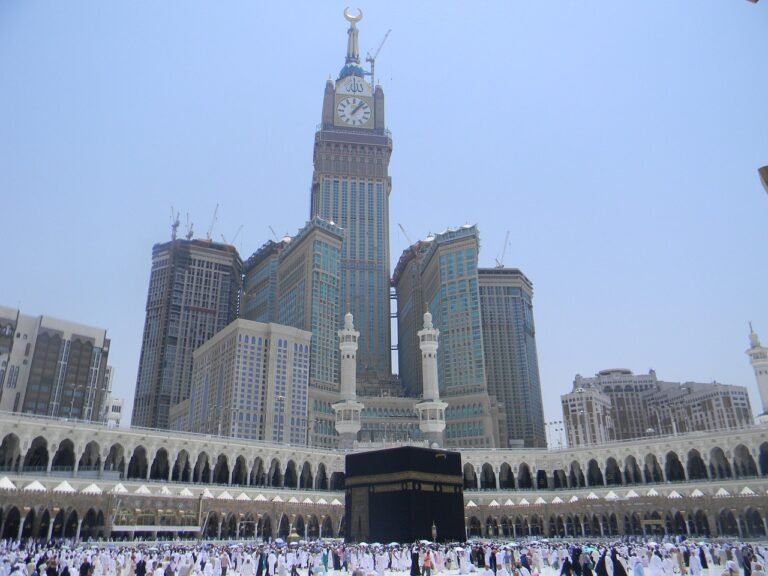
When you reach Makkah and have rested at the hotel, go to the Grand Mosque in a state of wudu, because purity is required for tawaf. Enter with your right foot and say the supplication for entering the mosque.
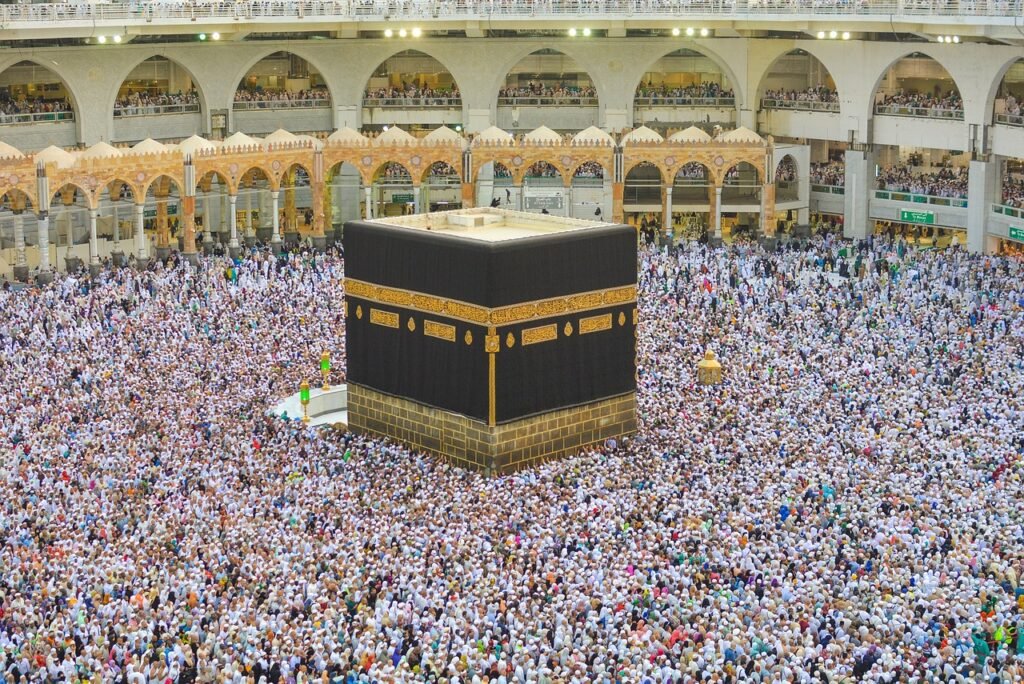
- Start: in line with the Black Stone (a green light on the mosque wall helps you find the starting line), with the Kaaba on your left.
- At the Black Stone on each circuit: touch or kiss it if that is easy. If it is crowded, point to it with your hand from where you are and say “Allahu Akbar”. Do not push or hurt anyone to reach it.
- The Yemeni Corner: touch it with your hand if you can, without kissing or pointing. Between it and the Black Stone it is recommended to say: “Rabbana atina fid-dunya hasanah, wa fil-akhirati hasanah, wa qina ‘adhaban-nar” (Our Lord, give us good in this world and good in the Hereafter, and protect us from the punishment of the Fire).
- For men: idtiba’ (uncovering the right shoulder) during the Umrah tawaf only, and raml (walking briskly with short steps) in the first three circuits if the crowd allows.
- Count: seven full circuits, each starting and ending at the Black Stone. Walk outside Hijr Ismail (the semicircular area next to the Kaaba).
- Supplication: there is no set prayer for each circuit. Make any du’a you like, in your own language, remember Allah and recite the Quran.
After tawaf
- Cover your right shoulder and pray two rak’ahs behind Maqam Ibrahim if you can, or anywhere in the mosque if it is crowded. It is recommended to recite Surat Al-Kafirun and then Surat Al-Ikhlas in them.
- Drink Zamzam water, which is available in many places inside the Haram.
Step 3: Sa’i between Safa and Marwa
- Go to Safa and, at the start of the first round, recite: “Innas-Safa wal-Marwata min sha‘a’irillah” (Indeed, Safa and Marwa are among the symbols of Allah). Then face the Kaaba, say takbir and make du’a.
- Walk to Marwa: that is one round. Coming back from Marwa to Safa is the second, and so on until you complete seven rounds, ending at Marwa.
- Men walk quickly between the two green markers (the green lights) on each round. Women walk at a normal pace.
- Wudu is not required for sa’i but it is better, and you may do sa’i on the upper floors if the ground floor is crowded.
Step 4: Shaving or shortening the hair
- For men: shaving is better, or shorten the hair from the whole head, not just a small part. Barbers are easy to find near Marwa.
- For women: gather the hair and cut a fingertip’s length (about 2 cm) from the ends.
With that, your Umrah is complete by the grace of Allah. You leave the state of ihram and everything that was restricted becomes allowed again.
Common mistakes to avoid
- Passing the miqat without ihram. This happens often on the plane, when people sleep or delay the intention, so listen for the crew’s announcement.
- Keeping the right shoulder uncovered from the moment of ihram. Idtiba’ is only for tawaf; the rest of the time the upper sheet covers both shoulders, especially during prayer.
- Believing every circuit has a fixed prayer that must be read from a booklet. Du’a is open, and in your own language.
- Pushing through crowds to reach the Black Stone. Pointing from a distance is enough.
- Men cutting only a few hairs from one side.
- Leaving ihram before finishing sa’i or before shaving or shortening the hair.
Tips for elderly and unwell pilgrims
- Wheelchairs and carts are available in the Haram for tawaf and sa’i. Ask your group supervisor about the best option at the time.
- Choose less crowded times for tawaf; your supervisor will help you pick the right time.
- Keep your medicines and a bottle of water in a small bag with you, and check the Umrah packing checklist before you travel.
A final tip
Read these steps once or twice before you travel, and memorise the talbiyah and “Rabbana atina fid-dunya hasanah”. For any religious question about your own situation, the religious supervisor travelling with the group is your reference. At Belquis Tours we guide you through the rites step by step with specialised religious supervision, so you can perform your Umrah with peace of mind.